
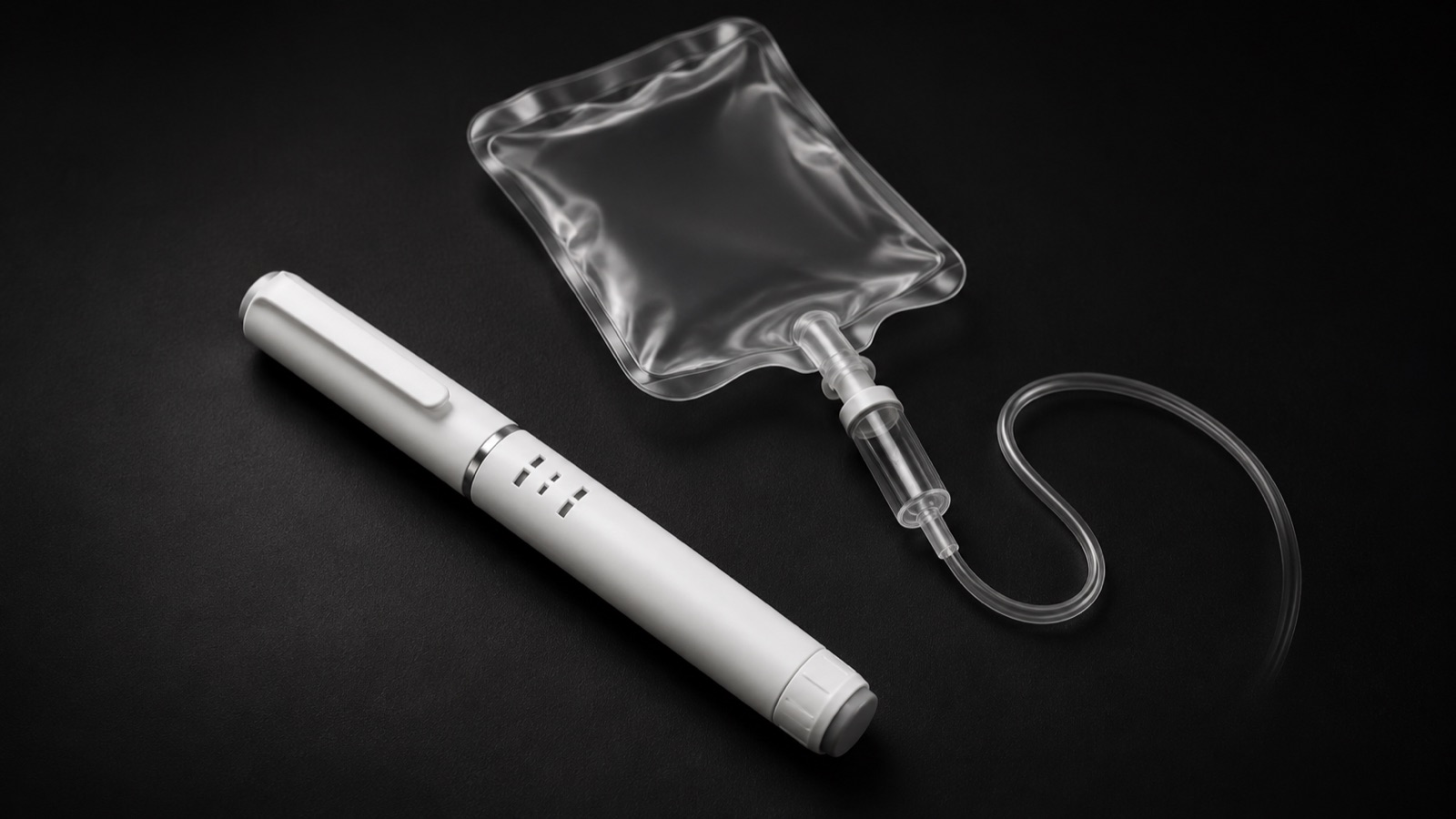
For physicians comparing NAD+ injections vs. IV therapy, the decision involves more than the route of administration. It also changes where care takes place, who administers the product, how patients receive support, and what resources the practice needs.
A prefilled NAD+ injection pen can support prescribed subcutaneous administration at home. IV NAD+ requires venous access and a supervised infusion workflow. Those operational differences are useful to understand, alongside the clinical evidence and the individual patient's needs.
Subcutaneous NAD+ vs. IV: the practical differences
Subcutaneous administration places a prescribed preparation into the tissue beneath the skin. Intravenous administration delivers it into a vein. A pen describes the delivery device; it does not, by itself, establish a product's clinical effectiveness.
| Consideration | Subcutaneous NAD+ pen | IV NAD+ therapy |
|---|---|---|
| Administration | Injection beneath the skin using the prescribed pen and its instructions. | Infusion through venous access using a clinician-managed protocol. |
| Care setting | May be self-administered at home after assessment and training. | Requires an infusion setting and qualified clinical personnel. |
| Practice resources | Patient education, prescription management, follow-up, and pharmacy coordination. | Venous access, infusion equipment, clinical monitoring, and chair or treatment space. |
| Patient time | No infusion appointment for each home dose; training and follow-up still take time. | Travel, setup, infusion, and any observation required by the protocol. |
| Support needs | Injection technique, device use, storage, sharps disposal, and reporting symptoms. | Venous access care, infusion tolerance, monitoring, and post-visit instructions. |
| Product handling | Patient follows the pharmacy label for refrigeration, handling, and beyond-use date. | The clinical team follows the preparation's labeling and handling requirements. |
| Evidence assessment | Requires evidence specific to subcutaneous NAD+ and the outcome of interest. | Requires evidence specific to IV NAD+ and the outcome of interest. |
On smaller screens, scroll within the table to compare both routes. This comparison describes care delivery; it is not a claim of equivalent dosing, safety, or clinical outcomes.
What does the human evidence establish?
The distinction between a biomarker finding and a patient benefit matters. In a 2019 pilot, Grant and colleagues studied eight men receiving IV NAD+ over six hours and three saline controls. They measured changes in plasma and urine NAD+ metabolites. The study did not compare IV administration with subcutaneous injections or establish long-term wellness outcomes. [1]
A 2026 retrospective pilot by Reyna and colleagues compared IV NAD+ with IV nicotinamide riboside (NR) in 14 clients: six receiving NAD+ and eight receiving NR. The study examined infusion tolerability, time, and laboratory measures. Infusion-related symptoms occurred in the NAD+ group. Its small, retrospective design limits generalization, and its comparator was IV NR, not a subcutaneous NAD+ pen. [2]
Neither study evaluated Medivive or establishes clinical equivalence between an NAD+ pen and IV NAD+. Findings about oral NR, oral NMN, or IV precursors also need to be evaluated within their own formulation, route, population, and endpoints.
For the prescribing conversation: explain the intended treatment goal, the strength and limits of the relevant evidence, and how response will be assessed. The studies above do not substantiate promises that a pen or an infusion reverses aging, extends lifespan, or produces superior clinical results.
How the route changes patient and practice workflow
IV therapy: plan for supervised administration
An IV workflow includes scheduling, patient assessment, venous access, preparation and administration, and monitoring during treatment. Infusion time depends on the prescribed protocol and patient tolerance. The six-hour schedule used in the 2019 pilot illustrates one study protocol; it should not be presented as a universal appointment length. [1]
Before offering IV NAD+, define staffing, assessment and monitoring procedures, escalation pathways, and documentation. Make sure patients understand the expected visit duration and how symptoms during an infusion will be evaluated.
A prefilled NAD+ pen: plan for education and continuity
At-home administration moves the injection out of the infusion setting. It also makes training, reliable communication, and follow-up central parts of the service. A prefilled NAD pen removes the need to draw each dose from a vial, while correct device use and injection technique remain essential.
Use a demonstration and patient teach-back to confirm understanding of the prescribed dose, device instructions, storage, and disposal. Give patients a clear contact for a delivery problem, device question, missed dose, or suspected adverse reaction. They should receive instructions from their clinician or pharmacist before changing a dose or schedule.
Assess the patient's ability to use the chosen format
For a home program, consider vision, dexterity, comprehension, needle comfort, access to suitable storage, and the availability of help when needed. An office visit provides direct supervision during administration; a home program requires a support plan that works between visits. Route selection follows the clinical assessment and informed discussion.
Evaluate compounded NAD+ quality for either route
For compounded NAD injections, source and handling deserve attention regardless of delivery format. FDA has warned about food-grade NAD+ being used to make IV products and has received reports of reactions consistent with excessive endotoxins after NAD+ injectable drugs. Ingredient suitability and sterile preparation are relevant questions for a physician's supplier review. [3]
Ask who compounds the preparation and who dispenses it. Review the applicable facility registration or pharmacy license, ingredient sourcing, batch traceability, sterility and endotoxin testing documentation, and the scope of the available Certificate of Analysis. Confirm shipping conditions, storage instructions, and the labeled beyond-use date.
Under FDA's framework, drugs compounded in 503B outsourcing facilities are subject to current good manufacturing practice requirements. FDA registration and cGMP requirements do not mean a compounded drug is FDA-approved. FDA does not review compounded drugs for safety, effectiveness, or quality before marketing. [4]
Use the product's current pharmacy label and instructions for handling decisions. If a shipment arrives outside its specified conditions, obtain pharmacy guidance before use. Document and evaluate suspected reactions; FDA encourages reporting adverse events involving compounded products through MedWatch. [3]
Compare total costs over the same period
A useful NAD+ pen vs. IV cost comparison accounts for the whole care model. For IV therapy, include the preparation, supplies, clinical labor, treatment space, and monitoring. For a pen program, include medication, delivery, needles and disposal supplies where applicable, training, clinical follow-up, and patient support.
Compare the same time horizon and the actual prescribed schedules. Make inclusions, refill arrangements, and patient charges clear. Patient travel and time away from work may also matter. A lower price per milligram does not establish equivalent exposure or therapeutic value across routes.
A practical checklist before prescribing NAD+
- Define the clinical rationale. Document the patient's goals, relevant history, medications, and alternatives.
- Discuss the evidence. Address uncertainty, potential risks, expected follow-up, and how benefit will be assessed.
- Verify the preparation. Confirm the compounding and dispensing pathway, product documentation, and labeled handling requirements.
- Specify the prescription. State the product, concentration, route, dose, and frequency clearly. Do not assume a milligram-for-milligram conversion between IV and subcutaneous schedules.
- Confirm administration readiness. Establish the infusion workflow or demonstrate the home device and confirm patient understanding.
- Set follow-up and escalation. Give patients clear reporting instructions and reassess the plan before continuing treatment.
Where Medivive fits in a physician-guided program
The Medivive NAD+ pen is a prefilled subcutaneous injector available through licensed prescribers, with pharmacy fulfillment directly to the patient. It gives practices a home-administration option within a physician-guided prescribing workflow.
The prescriber retains responsibility for clinical assessment, treatment decisions, counseling, and follow-up. The pen format addresses administration and fulfillment; it does not establish superior efficacy to IV treatment. For the practical setup, see our NAD+ injector pen implementation guide, including pen-versus-vial considerations, and the current patient usage instructions.
Common physician questions
Are NAD+ injections the same as NAD+ IV therapy?
They use different administration routes. A subcutaneous injection places the preparation beneath the skin; an IV delivers it into a vein. Product selection, dosing, supervision, and follow-up need to be considered for the specific route.
Is a NAD+ pen clinically better than an IV?
The human studies discussed here do not establish that conclusion. A pen may change the logistics of care, but practical convenience should not be presented as evidence of superior clinical outcomes.
Can an IV NAD+ dose be converted directly to a pen dose?
The studies cited here do not provide a validated conversion. Use a product-specific prescription and clinician judgment rather than transferring an IV schedule directly to a subcutaneous pen.
How do physicians begin evaluating a Medivive program?
Review the physician prescribing workflow and NAD+ pen details, then contact the team for current availability, documentation, and provider pricing.
References
- Grant R, et al. (2019). A pilot study investigating changes in the human plasma and urine NAD+ metabolome during a 6 hour intravenous infusion of NAD+. Frontiers in Aging Neuroscience, 11:257.
- Reyna K, et al. (2026). Intravenous infusion of nicotinamide adenine dinucleotide (NAD+) versus nicotinamide riboside (NR): a retrospective tolerability pilot study in a real-world setting. Frontiers in Aging, 7:1652582.
- U.S. Food and Drug Administration. FDA reminds compounders to use ingredients suitable for sterile compounding. Accessed November 5, 2026.
- U.S. Food and Drug Administration. Compounding and the FDA: questions and answers. Accessed November 5, 2026.
Published by Medivive for physician education. This article does not establish a treatment protocol or replace clinical judgment. NAD+ is a compounded preparation and is not an FDA-approved drug. Medivive offers a prescription NAD+ pen; product information and clinical evidence are identified separately above.